Profile Website Extra: More photos of Bob Grese’s garden

Continued from page 50 of the May 2013 issue.

Photos by Sandie Parrott

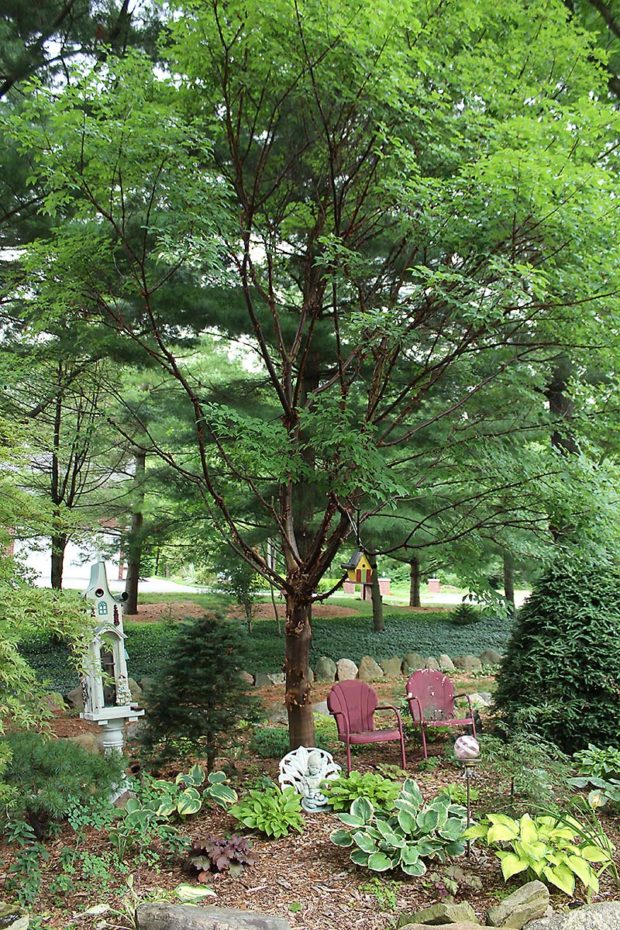
Bob Grese tends to a witch hazel tree (Hamamelis virginiana). Native Americans used the tree bark to treat sores, tumors, skin ulcers, sore muscles, coughs, and colds. Yellow blooms in early spring and yellow fall color make this a beautiful tree.

Bob Grese tends to a witch hazel tree (Hamamelis virginiana). Native Americans used the tree bark to treat sores, tumors, skin ulcers, sore muscles, coughs, and colds. Yellow blooms in early spring and yellow fall color make this a beautiful tree.


The striking plumes of bottlebrush grass (Elymus hystrix) in late summer are beautiful in any garden setting.

The striking plumes of bottlebrush grass (Elymus hystrix) in late summer are beautiful in any garden setting.


Grese grew Yukon Gold potatoes in what is typically called a grow bag. They are great reusable containers for vegetables and now come in many colors and sizes.

Grese grew Yukon Gold potatoes in what is typically called a grow bag. They are great reusable containers for vegetables and now come in many colors and sizes.


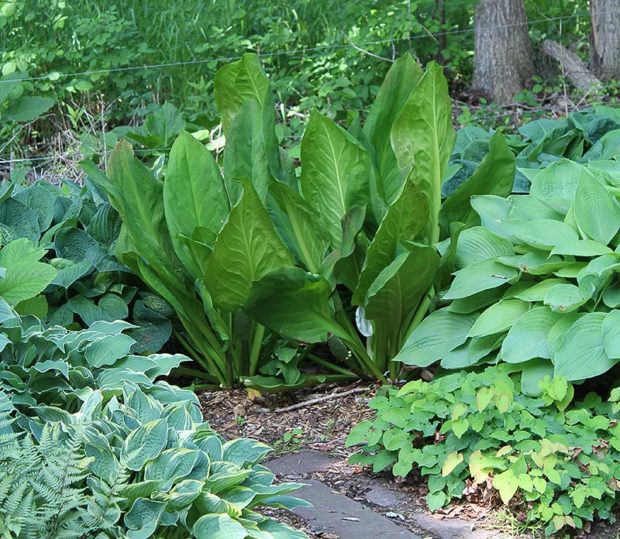
One of Grese’s favorites is prairie dock (Silphium terebinthinaceum). “I love the broad leaves and tall stalks. The leaves orient on a north-south axis and are wonderful backlit against the sun. The coarse texture is an effective contrast with fine-leaved plants,” he described.

One of Grese’s favorites is prairie dock (Silphium terebinthinaceum). “I love the broad leaves and tall stalks. The leaves orient on a north-south axis and are wonderful backlit against the sun. The coarse texture is an effective contrast with fine-leaved plants,” he described.

Janet’s Journal Website Extra: More edging photos and advice

Continued from page 54 of the May 2013 issue.

Photos by Steven Nikkila

Practical and pretty: This raised brick edge keeps loose material in the beds, nudges feet aside, and looks great in this traditional herb garden at Cranbrook House and Gardens in Bloomfield Hills, Michigan.

Practical and pretty: This raised brick edge keeps loose material in the beds, nudges feet aside, and looks great in this traditional herb garden at Cranbrook House and Gardens in Bloomfield Hills, Michigan.


There are no plants surrounding these beds at the Detroit Zoo so there’s no reason to install a root barrier. Yet there is need for a foot barrier in a place so heavily trafficked. Weathered logs and dead branches are used because it's readily available material that's in keeping with the overall landscape, where wood from pruning or tree removal is used in exhibits as animal enrichment.

There are no plants surrounding these beds at the Detroit Zoo so there’s no reason to install a root barrier. Yet there is need for a foot barrier in a place so heavily trafficked. Weathered logs and dead branches are used because it’s readily available material that’s in keeping with the overall landscape, where wood from pruning or tree removal is used in exhibits as animal enrichment.


Metal can be longer lasting than plastic edging but it is just as likely to be forced up out of the ground if not set in well to begin.

Metal can be longer lasting than plastic edging but it is just as likely to be forced up out of the ground if not set in well to begin.


Enjoy the look but don't rely on small fence or edge sections to block weeds. Even if they are deep enough to thwart the adjacent lawn or groundcover, they'll need help at the seams.
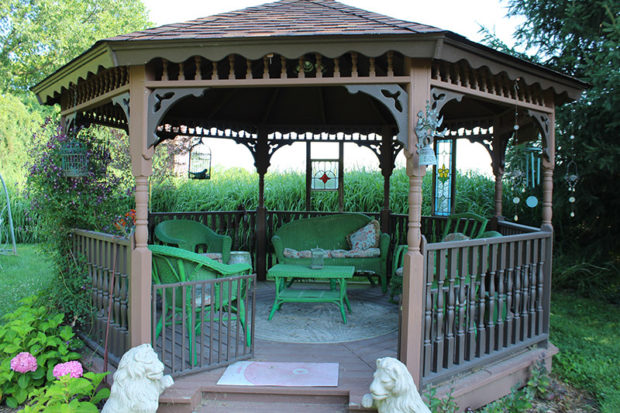
Enjoy the look but don’t rely on small fence or edge sections to block weeds. Even if they are deep enough to thwart the adjacent lawn or groundcover, they’ll need help at the seams.
Janet’s Journal Website Extra: Wattle wisdom and step-by-step to make Tollgate Twist

Continued from page 42 of the April 2013 issue.

Photos by Steven Nikkila

This basic wattle weave in and out of sturdy cedar posts will last at least 4 years and then only the withes will need to be replaced.

This basic wattle weave in and out of sturdy cedar posts will last at least 4 years and then only the withes will need to be replaced.

Priscilla Needle, Paul Needle, Debi Slentz, and others from our Detroit Zoo volunteer group harvest redtwig dogwood for wattle. It’s best to use fresh clippings, which remain flexible. However, cold storage that
prevents dehydration can extend the wood’s useful life. On this January day we seized an opportunity to cut a quantity of redtwig dogwood although we would not weave until April. It was a gamble but paid off in withes still quite flexible and ready when we were on April 1.

Making the Tollgate Twist

Materials needed:

  • Cut stems such as dogwood, willow, kerria, spirea, etc. in 4- to 5-foot lengths. Must be fresh, cut recently enough or stored cool enough to retain their flexibility.
  • A hammer or mallet and sturdy stake or pipe to punch post holes.
  • Biodegradable twine.

tollgate-twist-wattle1

1. Set three-part posts at 15-inch intervals along the desired fence line. Each three-part post consists of:

a. Two flexible weaving wands, 48 inches or greater. If the bottom 18 inches is rigid, not flexible, that’s okay but everything above that must bend easily. If the weaving wand has side branches you will treat the wand plus its twigs as one bundled unit.

b. One stout stake, its top at the desired finished height of the fence.

c.  All with their butt ends securely seated in drilled or punched holes about 6 inches deep. Depth of the holes depends on soil type and finished fence height. Looser soil and taller fences need deeper holes.

tollgate-twist-wattle2

2. Select a new 3- to 5-foot wand and weave it in and out around 3 or 4 posts. If this wand has side branches, treat it as one bundled unit. Pass alternately behind and in front of three-posts, and thread between each post and one of its weavers.

tollgate-twist-wattle3

3. Grasp the left-side weaving wand of post group A. Bend it to meet B, the next post to the right. Wrap down and around the three branches that make up post B, beginning between post B’s stout stake and left-side weaving wand. Wrap around the horizontal wand. Leave this weaver wand’s tip trailing on the ground. If a wand should crack, don’t let it break through completely, or replace it if it does.

4. Now bend and weave post B’s right-hand weaving stem to the left. Thread it between post A and its free weaver, then wrap around that post group.

tollgate-twist-wattle4

5. Weave to connect 4 or 5 posts. Then insert another 3- to 5-foot wand horizontally, as in #2, overlapping the first horizontal by half and alternating with it by weaving in and out between the posts.

6. Bend trailing tips of all weaving wands up to wrap around and run with horizontal wands. Tie with twine at intervals as necessary, or snug the wand tips into portions already woven.

7. Insert more 3-part posts and keep weaving.

Website Extra: Asian Inspired Garden

Continued from page 36 of the April 2013 issue.

Photos by Sandie Parrott

Rita calls this her tiger lily walk. Many were donated by friends. As a girl, Rita loved to go and pick them in the fields and present them to her mother. She loves the mass effect and passes along extras to her friends.
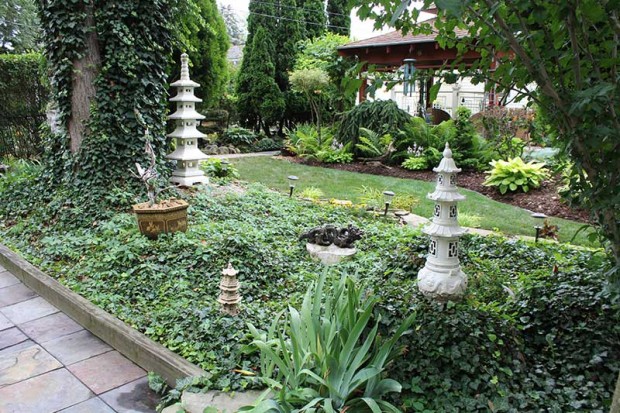
Rita calls this her tiger lily walk. Many were donated by friends. As a girl, Rita loved to go and pick them in the fields and present them to her mother. She loves the mass effect and passes along extras to her friends.
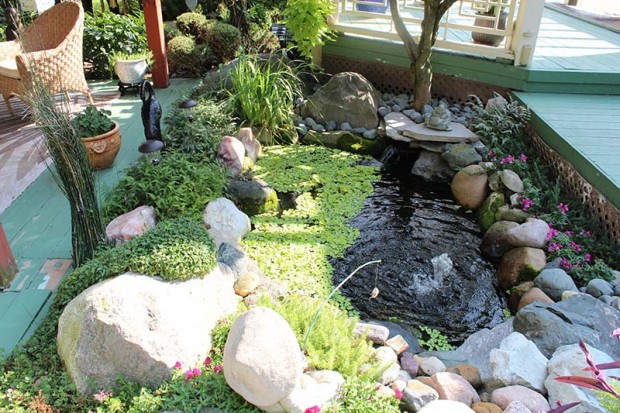
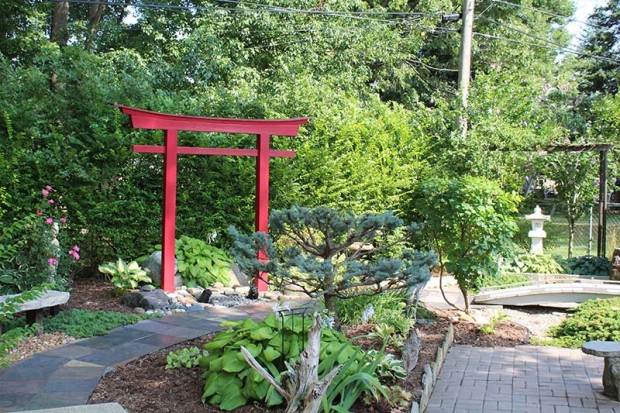
Slag sand pathways allow the Cohens and visitors to stroll the garden. The red color of the bridge sets off the garden and adds the traditional feature of a Chinese garden, which some Japanese gardens have adopted. Japanese gardens typically have natural wood or stone bridges.

Slag sand pathways allow the Cohens and visitors to stroll the garden. The red color of the bridge sets off the garden and adds the traditional feature of a Chinese garden, which some Japanese gardens have adopted. Japanese gardens typically have natural wood or stone bridges.

This view is full of texture: a little wire animal perches on a stone bench while the stark driftwood piece draws the eye upward to the massive old sugar maple tree. Tiny-leaved creeping thyme groundcover anchors the scene.

This view is full of texture: a little wire animal perches on a stone bench while the stark driftwood piece draws the eye upward to the massive old sugar maple tree. Tiny-leaved creeping thyme groundcover anchors the scene.

Website Extra: Planting on a hill

To read the full Janet’s Journal, “Anti-gravity gardening: Planting on a hill,” pick up a copy of Michigan Gardener (in stores by Sept 5) or check out page 32 in our e-edition of the September/October Issue.

Stones meant to slow water’s fall, reinforce or retain a hill
should not sit on the surface where they can slip.

ledge-cut-into-hill

stone-placed-on-first-ledge

second-ledge-prepared

second-stone-placed

In the series above, a stone placed on a step cut to lean back into the hill. The next stone also leans back, and its face is set back away from vertical. Given stones stacked across the face of the hill, this setback would create a “battered” retaining wall. A batter of 1” back for each 12” rise stabilizes a retaining wall.

edinburgh-rock-garden

At the Royal Botanical Garden in Edinburgh, Scotland, this 1.75:1 slope (57 percent) features artistically placed boulders but the main retainers are plants.

san-bernadino-slope

Those of us who garden on relatively flat lands may gape at how slopes are handled in hillier regions. Once you know something about terracing, you may focus as much on the ways this feat is accomplished as on the unusual plants you see in faraway places. Residents’ attitudes toward hills and their skill in dealing with them can be worth note, too. That is, the residents of up-and-down neighborhoods in the foothills of California’s San Bernardino Mountains regularly stabilize long, steep hills solely with plants such as these rambler roses and honeysuckle vines.